Big Tech Investment Series - Tesla
- Paul Robert
- Feb 22, 2025
- 4 min read

We are bound to thank God always for you, brethren, as it is fitting, because your faith grows exceedingly, and the love of every one of you all abounds toward each other,
2 Thessalonians 1:3
God is the creator of the universe, and it is truly amazing that God uses human relationships to proclaim the Gospel message. Just as Jesus Christ sacrificed His body for the sake of all humanity, the Body of Christ is transferable in the work that Christians do collectively to show God’s love as an extension of what they have received from Him. Jesus Christ was alive and lived on earth being relatable to us as a model of perfect living. We must support one another to reciprocate what He has done for us.
Retail investors similarly can benefit from support. At a minimum, having an alternative to the pressures of Wallstreet and social media is important for a balanced view. While social media may seemingly be balanced with varying perspectives, it has quickly become a similar tool to exert pressure on retail investors rather than provide objective analysis. This is especially true for longer-term investors as trading strategies dominate information flow heavily influenced by Wallstreet.
The next company in the Big-Tech investment series is Tesla, Inc. (TSLA).
Key Takeaways for Retail Investors
TSLA is down 16 percent to start 2025, but the company still is trading at a premium at 73 times operating cash flow per share.
TSLA continues to trade at a premium which has been the case since 2019 based on the robotaxis opportunity. While this has yet to substantially impact the company’s revenue, TSLA remains the clear leader in the technology.
The EV industry has witnessed a slowdown, notably in the U.S., and TSLA has not been immune to this impact. Even with robotaxis business being delayed over the mid-term, TSLA can still see a return to EV sales growth be a core driver for stock price appreciation.
When it comes to Big Tech, TSLA, like NVIDIA Corporation (NVDA), are the two growth leaders. This role will likely remain as both companies are willing to take the greatest risks to generate shareholder returns.

During 2018, TSLA witnessed inflection on many levels as revenue crossed $20 billion. Since this time, TSLA has averaged 66 times operating cash flow per share and 10.7 times EV/Sales. TSLA has consistently maintained a premium as analysts continue to expect robotaxis to emerge as a massive tailwind over time. The recent slowing demand for electric vehicles, or EVs, has impacted the company’s top-line to date.

TSLA’s gross and operating cash flow margins have dropped a little lower than the pandemic peaks. During 2024 operating cash flows increased modestly, but with the decline in EV deliveries for the first time in TSLA’s history, this result was not ideal. Gross margin has remained somewhat steady for the past two years after peaking in 2022.

As stated, TSLA’s revenue performance has declined dramatically with the EV slow down leading to negative revenue results for 2024. Analysts expect that TSLA will return back to double-digit growth over the next couple of years and it remains to be seen whether TSLA can see anything close to 50 percent growth as in the company’s recent past.

TSLA’s cash flow has led to peak nominal results on the operating cash flow side. The company remains in a very strong position despite slowing EV demand. TSLA has continued to invest substantially in the company’s capex programs. Since 2018 this has totaled $40.5 billion and is a healthy sign of continued innovation and strategy risk taking.

TSLA rarely makes deals or buys back any stock. This has resulted in the company realizing a substantial amount of cash and investments, which grew quite well during 2024 adding fundamental strength to the company in a down year. Early on TSLA relied upon its debt structure to provide its capital investment needs, today, the company’s balance sheet is pristine.

TSLA’s automotive revenues remain substantially higher than its other primary revenue segments. This is expected to be the case for TSLA’s future as well as the company attempts to transition towards robotaxis revenues. Even the services and other revenue today includes automotive-related revenues and robotaxis revenues will likely also either be embedded within a services revenue segment, and/or eventually become a separate revenue segment.
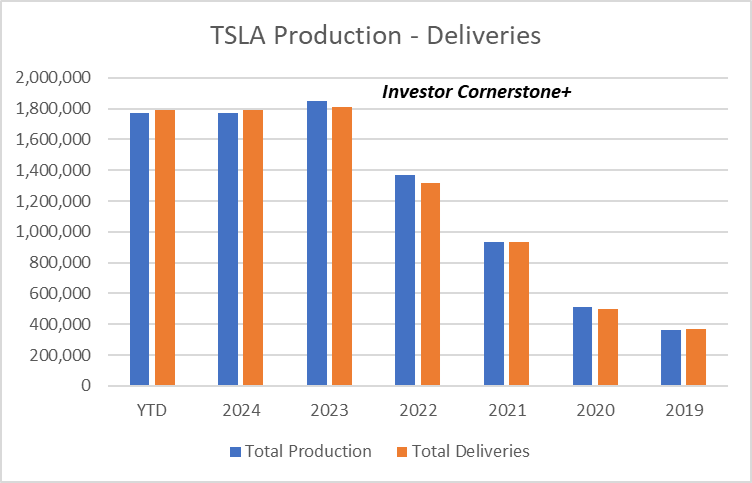
TSLA’s deliveries were down marginally by a percent during 2024 with just fewer than 1.8 million units delivered. For the U.S., TSLA delivered approximately 634,000 units reflecting 48 percent of the entire market. Competition continues to heat up, however, sustainability of the many new EV makes and models is not guaranteed, especially as discounting has been occurring of late to generate sales and consumers will continue to compare EV products versus alternatives as the U.S. federal administration is not as aggressively pushing the EV transition.
Final Thoughts
TSLA is a tough company to model over the mid-term. On the one hand, one can be conservative and focus predominantly on the current revenue streams continuing to be the core driver for performance. But at some point, the expectation will increase to see the company transition towards the robotaxis opportunity. If the former outcome remains the case, TSLA will need to command a higher premium towards 50 times cash flows to generate annualized returns north of 15 percent. Over the past six years, this premium has been justified based on future potential.
If robotaxis revenues remain delayed for longer, then at some point TSLA’s valuation level may contract unless a resurgence in EV production and deliveries takes place. This is a scenario that most are not going to accept, but the reality is that autonomous driving technologies have remained elusive across competitive peers whether Alphabet, Inc.’s (GOOG) Waymo or General Motors Company’s (GM) Cruise. The good news for investors is that there is still a major technology play opportunity from EVs that TSLA can continue to be justified in a premium stock price.
Try a Portfolio Moves & Stock Market Analysis free trial to get more in-depth analysis of companies like TSLA, including actionable ideas on how retail investors can benefit from the Wallstreet game.


Comments