Big-Tech Investment Series - Alphabet
- Paul Robert
- Feb 4, 2025
- 6 min read

For we do not wrestle against flesh and blood, but against principalities, against powers, against the rulers of the darkness of this age, against spiritual hosts of wickedness in the heavenly places. Therefore take up the whole armor of God, that you may be able to withstand in the evil day, and having done all, to stand.
Ephesians 6:12-13
As a Christian, there are two drivers of how one lives, the body or flesh and the spirit. The Bible tells me that I must be born again to receive salvation. I must be born of the spirit which Jesus Christ gave to all after his resurrection and return to heaven. For me to be equipped to wrestle against the evil powers and principalities not of this world, I must receive salvation and the Holdy Spirit through accepting Jesus Christ as my Lord and Savior. The armor of God is His word that serves as both protector and enabler to fight against this darkness that usually manifests through subtle temptations.
I am called to “be able to withstand” and to “stand”. To withstand or stand firm amid pressure and chaos from financial markets, conviction is the only way. Conviction and faith go together. Faith may appear to be illogical, but it cannot be separated from what is tangible and real just like conviction. Just as I must grow and mature in my faith with Jesus through the Holy Spirit to recognize who my enemies are and equip myself accordingly, I must constantly be aware of the psychological and emotional dangers surrounding me while I maintain conviction in managing my investments and dealing with Wallstreet.
The next company in the Big-Tech investment series is Alphabet, Inc. (GOOG).
Key Takeaways for Retail Investors
GOOG is expected to drop fairly hard tomorrow and this will present investors with a potential opportunity to initiate or accumulate shares where a double-digit annualized return over the mid-term will be likely.
GOOG has some striking similarities as META as both companies’ stock prices are extremely sensitive to revenue performance resulting from their stagnant cash flow margin results over time. Additionally, both companies are strongly tied to advertising revenues, which makes them more cyclical than other Big-Tech peers.
Primary concerns for GOOG based on quarterly outcomes relate to slowing cloud segment results and ability to compete within the AI space. This is a critical point of reflection and consideration as Wallstreet hype has been a core driver for Big-Tech valuation levels and to varying degrees, this is unsustainable.
To the point of these quarterly concerns, GOOG will be required to increase its capex. This presents issues as increased capex spend is no guarantee for returns on investments as GOOG’s culture has shifted to a conservative stance. Additionally, it will conflict with Wallstreet’s control over the companies’ stock buyback policies and recent dividend initiation.

Since 2017, GOOG’s operating cash flow per share has normalized plus or minus at 20 times. The higher fluctuations for enterprise value to sales are driven more so by changes in shares outstanding and cash and investments and debt positions. This is a primary reason why GOOG is not overvalued and will continue to give investors an opportunity based on this valuation level. It is very similar to Meta Platforms, Inc. (META) whereas GOOG’s substantial revenue is generated through advertising and the transition to artificial intelligence, or AI remains elusive.

Also, like META, GOOG’s gross and operating cash flow margins have remained stagnant, being primarily impacted by economic cycles over shorter periods. The recent inflationary cycle over the past four years has led to GOOG seeing a current peak cycle from the 2020 downtrend.
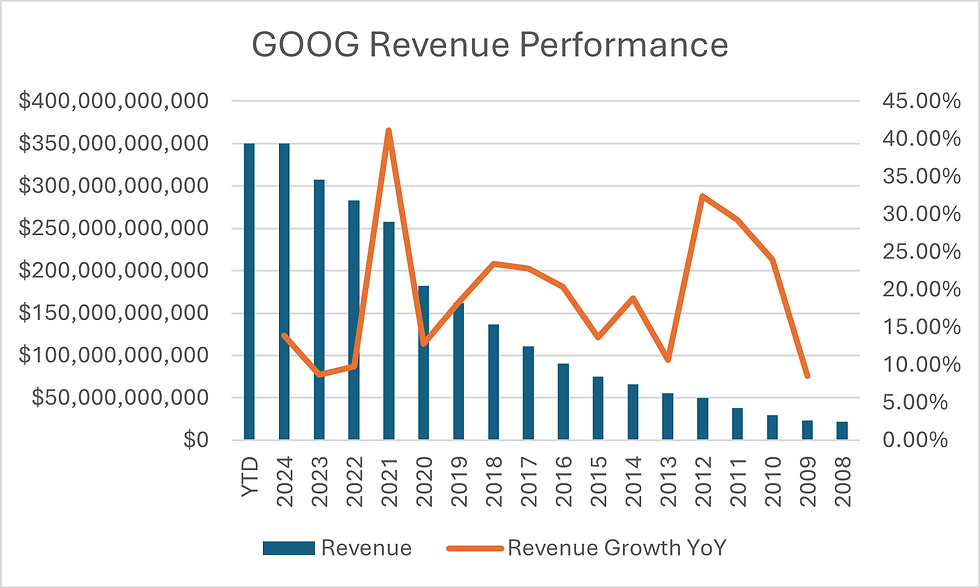
As cash flow margins have remained stagnant, revenue performance like META, has been the primary driver for GOOG’s stock price performance. GOOG relies heavily on advertising through its search services, other GOOG properties, services, and subscriptions, and network member properties. The 2021 41 percent increase in revenue anomaly driven by the pandemic was a boon for GOOG. Excluding that year, the other four years have witnessed sub-15 percent annual growth, which is the lowest period of performance over the past 17 years.

Nonetheless, GOOG’s cash flows have led to much higher nominal results. The challenge for GOOG has more recently been the need to increase investments towards newer revenue streams to diversify its business.

However, much of GOOG’s cash flow has been prioritized towards stock buybacks which serves as an imbedded form of earnings manipulation to appease Wallstreet. Stock buybacks also often lead to serial under-investment and reduced risk taking. Big-Tech continues to try to ‘have its cake and eat it too’ and Wallstreet is a major facilitator of this through hyping growth potential when the reality far too often is the opposite.

GOOG has not been a serial growth-by-acquisition company akin to Microsoft Corporation (MSFT). The company has instituted a dividend like META and this likely will increase over time. But the current dividend yield stands below 0.3 percent, which is typically associated with growth-oriented companies. This is a major disconnect and another indication that while GOOG may not be extremely overvalued by cash flow metrics, it is when accounting for enterprise value to sales and the dividend yield.

GOOG has yet to run into any issues with respect to gross debt increasing because of stock buybacks. But since the 2021 cash and investments peak, stock buybacks, increasing dividends, and capex amounts have reduced this area. Investors should be paying strict attention to this as based on GOOG’s capex expectations for 2025 and beyond, supporting these three pillars will not bode well and increasing gross debt will begin to develop.

GOOG search and other associated revenue is the major driver for the company’s performance. The 10-K is not filed yet so all the data is not yet reflected for 2024. Fifty-five percent of the revenue total may not seem extreme, but it is still nearly five times greater than any other revenue segment.

For GOOG’s other services, subscriptions, platforms and devices have continued to be the primary growth driver. YouTube ads have begun to slow despite 2024’s uptick, which is a testament to competing daily streaming user time.

GOOG Cloud clearly has been the leading segment from a growth perspective. With GOOG’s earnings announcement, concerns over this segment’s recent results and prospects as well as GOOG’s ability to transition to increasing AI opportunities have been drivers for the dip in the company’s stock price. While most investors have bought into the AI hype literally and figuratively, most Big-Tech peers are not effectively generating new products but rather are leveraging existing dominant segment models with adaptative AI augmentations. This places increasing uncertainty on the degree of increased sales and margins performance from these AI endeavors.

The last two areas for investors to consider are GOOG’s own paid clicks and costs-per-click, and network members’ properties impressions and costs-per-impression. The days of GOOG witnessing robust increases for paid clicks and incentivized lower costs-per-click have gone away. Inflation has pushed costs-per-click higher, which has become atypical and paid clicks have not witnessed greater than 10 percent growth since 2021.

GOOG network members’ properties have historically witnessed more gyrations in impression performance. During the last contraction period prior to the pandemic, costs-per-impression lessened while impressions were choppy. These metrics improved during President Trump’s first administration. Since the year 2020 pandemic, impressions have been weakened as GOOG has prioritized its own properties much more, but still during some years substantially increased cost-per-impressions across these other properties.
Final Thoughts
GOOG and META are very similar with respect to their dependence on revenue growth and murkiness regarding their potential to further diversify revenue streams and innovate beyond existing revenue segments for AI opportunities. They are both much more cyclical than other Big-Tech peers as advertising is a core component for their revenue generation. And yet, because of their stock price volatility, investors who are savvy buying at the right situations can still potentially generate stronger returns than other Big-Tech peers.
Both the U.S. and Europe have attempted to crack down on Big-Tech and GOOG is a great example of when and if a ruling comes out to break up the company, having separate investment options will likely unlock greater value over time. The tendency though is for the commingling of Wallstreet, and today’s distorted political influence continues to drive the ‘have your cake and eat it too’ mantra which ultimately restricts innovation and risk taking and more competitive and fragmented markets.
Try a Portfolio Moves & Stock Market Analysis free trial to get more in-depth analysis of companies like GOOG, including actionable ideas on how retail investors can benefit from the Wallstreet game.

Comments